
Contents of Article
 Though modern socio-cultural and neuro-normative narratives may not recognise it nor appreciate it, we are created as affective and adaptive, dispositional and dynamic, neuroplastic beings who are inherently ever-emerging and Self-organising.
From the moment we are born to the moment we die, we seek connection, protection, autonomy, and belonging with communicative meaning-making, not as optional extras, but as conditions of survival within an interconnected field of life.
And yet modern life often promotes the idea that we should be independent, Self-contained, and Self-regulating beings, as though this were the singular measure of maturity and health. In many settings, power and dominance promote control and order, and relational life becomes organised around rank, compliance, performance, and containment. Under such conditions, inter- and intra-personal dynamics often reflect imbalance, injustice, isolation, and a disconnection that permeates our sense of Self. Rather than movements toward connection, protection, autonomy, and belonging with communicative meaning-making, movements can become shaped by chaos, meaninglessness, and a deep sense of alarmed-aloneness.
Here is the central proposition. There exists a depth of complexity within and between the Self, the Other, and the World that surrounds us. When we honour this complexity, we open space to understand that we are embodied and relationally embedded.
We are not limited to a body and cannot be understood without an all-encompassing, complexity-embracing perspective. In this way, we invite a shift away from seeing distress as something located solely within the individual and something to be fixed, and toward the recognition that who we are is inseparable from where and how we live.
Health and wellbeing involve more than symptom reduction, because symptom expression is often a surface expression of deeper spatiotemporal patterning across Self, Other(s), and World.
This is a lived phenomenological reality. Our systems are shaped by experience, and experience is never only internal. It is relational, environmental, cultural, economic, historical. The body holds memory in implicit forms. The mind makes meaning through sensation, perception, and interpretation.
Relationship shapes expectation, safety, and the capacity to remain present. When the World that surrounds us is organised in ways that erode belonging, distort trust, and reward disconnection, it is unsurprising that people experience despair, mistrust, dysregulation, or collapse. It is not that the Self is substandard. It is that the Self is responding, adapting, and organising under conditions that may not support coherence.
When distress is located solely inside the individual, the person becomes the problem. The context disappears. The relational field disappears. The histories of safety and threat disappear. The structural conditions of injustice disappear. And so the protective patterns that have arisen can be misread as pathology, stubbornness, weakness, or personal failure. When we honour complexity, a different understanding becomes possible. Protective patterns can be recognised as intelligible responses to lived conditions, as adaptations that preserved survival, continuity, and belonging in the only ways available at the time.
We could say it simply, without reducing it. The Self is not only a noun. The Self is a process. The Self is an embodied system shaped within relationship, embedded within environments, organised across time, and continually influenced by the World that surrounds us.
Who we are is not merely what we think, or what we do, or even what we feel. Who we are includes what we sense, how we perceive, how we interpret, and how our system learned to respond under particular conditions. What later appears as anxiety, withdrawal, hyper-vigilance, emotional numbing, self-criticism, perfectionism, appeasement, or control often began as coherent protection within incoherent circumstances.
 Context is often treated as background, a secondary feature that sits around the “real issue.” Yet context should never be a side note. Context is the living condition in which the Self formed.
Broadly speaking, context refers to the interrelated conditions in which something exists. More specifically, context includes the internal and external constraints that shape how energy and information move within and between Self(s), Other(s), and the World. These constraints include relationship patterns, roles, power dynamics, culture, economics, belief systems, social position, and histories of safety and threat. Context is therefore not simply content, not simply what happened. Context includes the conditions under which what happened was sensed, perceived, interpreted, and embodied, and how those patterns continued to reorganise across time.
This matters because human experience is not linear. We are not shaped by one event in one moment in a direct cause-and-effect line.
We are shaped through reciprocal influence, through repetition, through accumulation, through relational dynamics that stabilise certain expectations and foreclose others. What becomes “me” is not merely who I decided to be. What becomes “me” is often how my system organised in response to what was required, permitted, punished, or absent in the environments I lived within.
When context is made visible, several shifts become possible. Shame begins to soften, because the Self is no longer framed as defective. Confusion begins to clarify, because protective patterns can be linked to their original function. Compassion becomes more grounded, because it rests in understanding rather than sentiment. And change becomes more realistic, because it is no longer reduced to willpower or insight alone, but understood as an emergent process that requires conditions supportive of reorganisation.
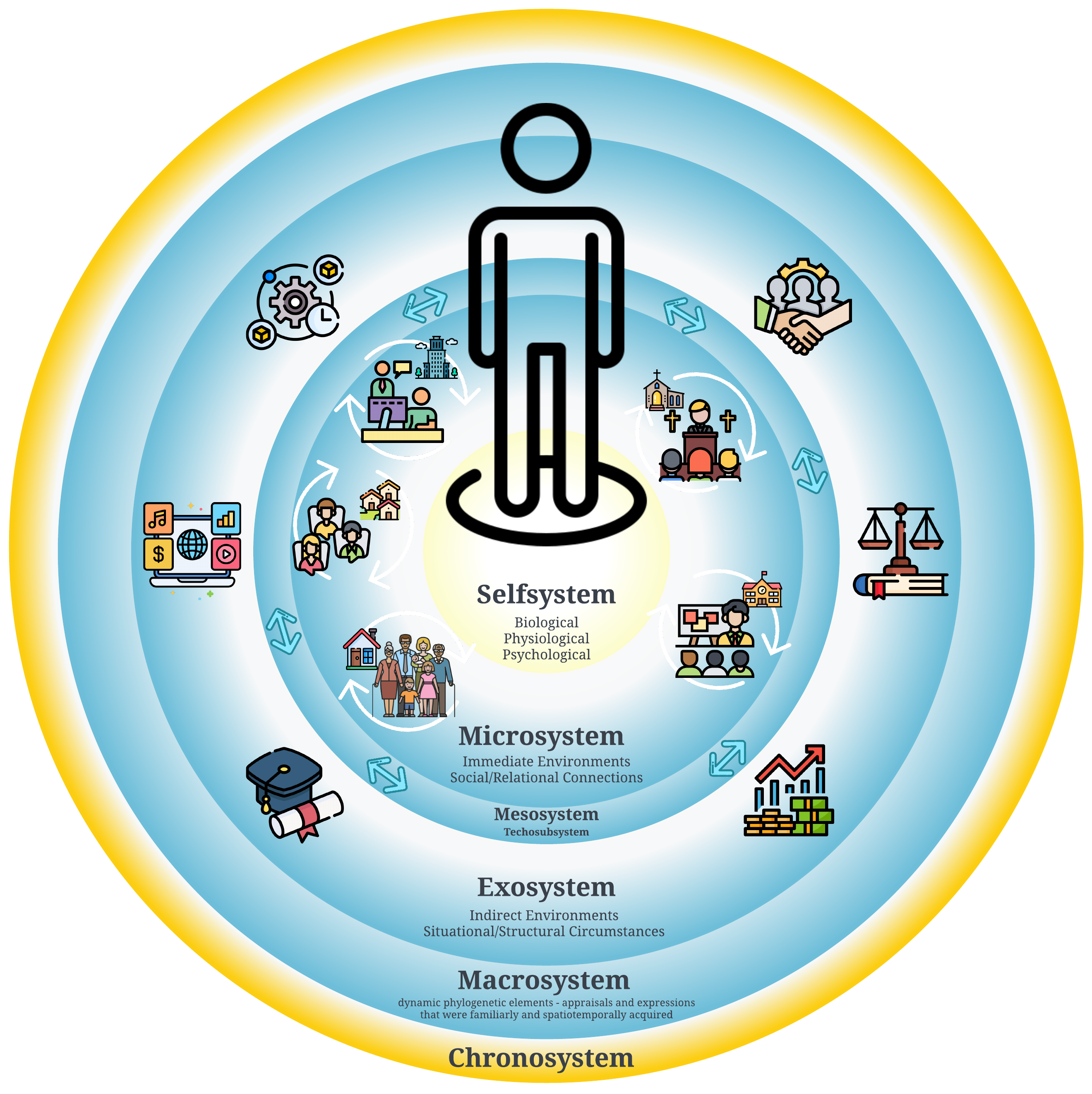 One way to hold the full complexity of context is to recognise that we live within layered systems, nested environments that interact with and shape one another. Some of these systems are intimate and immediate, and some are distant yet still influential. Some involve direct participation, and some affect us without our direct involvement. The point is not to memorise categories. The point is to see that Self(s) and Other(s) do not exist apart from the World that surrounds us, and that distress, too, must be understood within these layered conditions.
At the most immediate layer are the settings in which we have face-to-face life. Home. Family. Close relationships. Workplace. School. Religious community. Social groups. These settings hold patterns of roles, expectations, recognition, and power. They shape what is permitted to be expressed, what must be hidden, how conflict is navigated, how safety is offered or withheld, and what kinds of connection are possible.
Then there are the interrelations between these settings, the ways one world speaks to another, and the ways a person must travel between them. How does family affect work? How does work affect parenting? How does culture shape what can be spoken at home? How do community values shape what the Self is allowed to want? When settings communicate well, when trust and mutual regard exist, when power is not excessively imbalanced, a person’s system is more likely to experience coherence. When settings contradict each other, when a person must compartmentalise to survive, when belonging in one setting requires disowning oneself in another, fragmentation and alarmed-aloneness more readily arise.
There are also settings that shape our lives without our active participation. Institutions, workplaces of caregivers, organisational decisions, medical systems, legal systems, funding systems, broader community events. These forces can alter stress load, access to resources, exposure to harm, and the felt sense of future. A person can be deeply affected by events that happen “elsewhere,” precisely because the Self is relationally embedded, not isolated.
And then there is the broader cultural layer, the macrosystem, which includes belief systems, ideology, norms about autonomy and dependence, attitudes toward mental health, trauma, disability, gender, class, race, religion, and worth. This layer quietly shapes what is respected, what is dismissed, what is blamed, what is celebrated, and what is silenced. When the macrosystem values productivity over wellbeing, independence over interdependence, and compliance over authenticity, many people internalise distress as personal failure rather than as a signal of contextual strain.
Through all these layers runs time. What was adaptive in one season may become restrictive in another. What kept a person safe in a childhood environment may become a source of suffering in adult relationship. A protective pattern can remain in place long after the original threat has passed, not because the person is choosing it, but because the system is organised around an earlier reality. In this way, context is spatiotemporal. It is patterned across time, carried in the body, and reactivated in present-day relational fields.
When we hold this complexity, protective patterns become understandable as the Self’s attempt to create coherence under conditions of threat, instability, disconnection, or relational danger.
Protection may take many forms. It may involve vigilance, control, appeasement, withdrawal, self-reliance, intellectualisation, perfectionism, numbness, or collapse. Each pattern has meaning. Each pattern has a function. Each pattern is an adaptation that once served survival, even if it now comes with cost.
 And yet, complexity also includes hope. Self-organising systems can reorganise. Neuroplastic systems can change. Human beings can move toward coherence, integration, and renewed vitality, particularly when conditions support safety, connection, autonomy, and belonging, with communicative meaning-making.
This is why health and wellbeing involve more than symptom reduction. Symptoms can reduce without coherence. Symptoms can return when the underlying conditions remain unchanged. Symptoms can shift forms when meaning has not been made.
Wellbeing, in a deeper sense, involves the cultivation of contextual coherence, the capacity to sense the present as distinct from the past, the capacity to remain embodied in relationship without losing Self, and the capacity to respond with greater flexibility rather than being driven by protective necessity.
When context is honoured, the Self is no longer framed as broken or failing. The Self is framed as shaped. The question becomes less “what is wrong with me?” and more “what has my system had to do to survive, and what might it need now to move toward greater contextual coherence?” This shift does not remove responsibility or accountability. It relocates responsibility into reality. It invites us to take accountability by working with the actual conditions that shape human life, rather than pretending we are isolated units who should be able to fix ourselves in a vacuum.
 Welcome, my name is Chele, I am a therapist primarily specialising in Trauma – specifically as it presents as Burnout and Breakdown. As a psychotherapist & PACFA & CCAA Clinical Counsellor I work individually with beautiful humans such as yourself who feel alone, lost, confused, & overwhelmed; those of you who are longing for something different.
As such, I offer my knowledge, skills, and inherent gifts with ears that listen to hear, and a heart open to receive who you are, no matter the suffering you bring; to support you in an exploration of how your past has impacted you and the ways that shows up presently. Together we will rediscover your hope and your sense of Self; we will reconnect you to what matters reclaiming the joy and delight in life you so deserve.
I welcome you to view my services or connect with me to explore how I can assist you in your journey.