
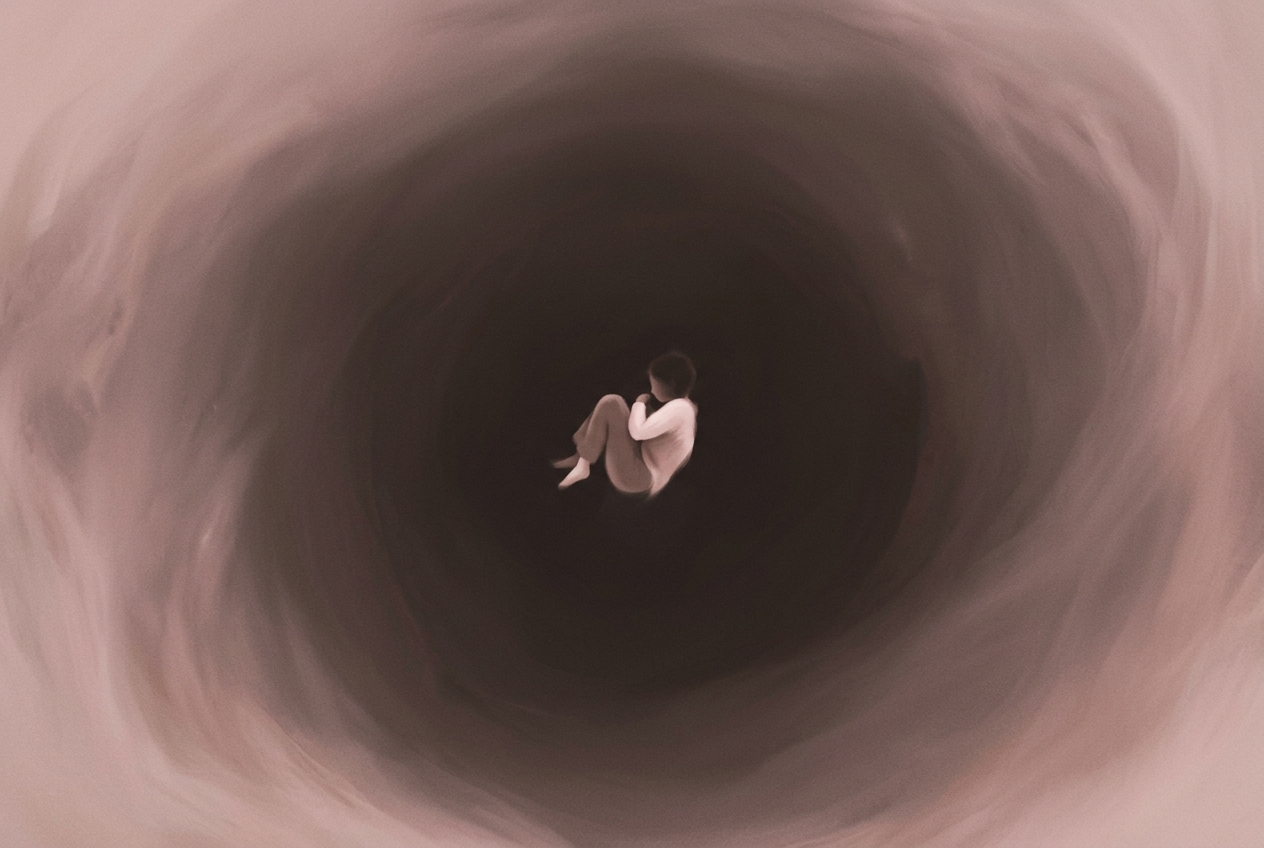
 There is a space, a darkness, an abyss of bleak nothingness that so often moves within us. Such a space can often feel like a chasm that so quickly fills with the overwhelming silence and alarmed aloneness.
In the chasm, a void exists. The felt sense of being alone and not knowing. Of falling, and falling, with nowhere to meet the ground. An emptiness that holds no words. This void so oft filled with a soundless screaming for someone to come, yet no one comes. No one is coming. The silence itself uncontainable in its desolate unknowingness.
Often what awakens this desolate unknowingness and its ensuing chasmal void is the relational rupture that holds no sense of opportunity for repair. A distressing non-sense of sorts. There is a kind of ending, a cut-off, an interaction that ended in silence and withdrawal, or a death that leaves more unknown than what was ever known.
There within the unknowing lies the overwhelming silence and alarmed aloneness. And within this, and perhaps you know this well, parts of us quickly move in to protect against the distress of separation. Maybe the most familiar parts here are the ones that work hard to figure things out, the ones that work hard to understand what is happening, why it is happening, and how it is happening.
Again, and again, and again. The repeat is exhausting, yet inescapable, no matter how hard we try to pull or push these parts out of it.
The fatigue is real, and as the exhaustion of the unknowable and the swirling uncertainty continue, so too does the overwhelming silence deepen. The pull of parts wanting to find rhyme and reason always returning, each time louder, yet each time more wearied. Each time still overwhelmed, alarmed, and alone, left in the silence of unknowing.

Even here we might notice that so often the World names our figuring-out parts as ‘rumination’, as ‘overthinking’, and as something to quickly rid our Self of.
Yet, perhaps what is needed is something more, not less.
It may be that a more poignant move would be to wonder together what exactly these parts of us are reaching for in their ‘what’, ‘why’, and ‘how’.
Quite often the parts of us that figure things out, pulled toward understanding the Other, are the ones that learned so long ago that the only way to digest and metabolise the fragmenting affect of ongoing rupture without repair, as well as to preserve orientation, proximity, and attachment, was to orient to the Other’s motives first. That is, to turn toward the Other with a conception of their internal world, to seek and sense their affective drive first and foremost.
Over time, and with continued orientation to the Other, we learned to protect our innermost being, our innate sense of Self, through figuring out the reasons for the silent absence. These parts of us learning that figuring things out alone helped to ease the intensity of the distress of separation. And indeed, at times the parts of us that figure things out are able to conceive of ways to restore the needed proximity to an Other. To restore a sense of coherence within and between the desolate spaces of an incoherent World through a discernment of languaged logical understanding.
These parts of us protecting us for so very long. Yet at the same time, whilst these parts of us served us well, and still serve us well, in preserving the orientation, proximity, and attachment needed in the service of survival, other parts of us have been left without the needed relational-regulatory responses of an Other. These parts never quite able to digest and metabolise the intensity of the distress of separation. Often these are the younger parts of us that were ambiguously left without an attuned Other in the distress of separation, in rupture without repair, time and time again.
Indeed, what we may now conceive here is the diffuse descent that occurs without spaciotemporal steadiness: the movement from the parts of us that figure things out and understand the Other to the youngest parts of us that are discombobulated, dissonant, dissociated.
 Perhaps this can also be seen as the descent into the unmet affect of our youngest parts. For back then, for many of us even before our capacity for language and logic had a chance to develop, the experience of separation lives in the primary processes of our very existence.
When we are young, Self’s separation from the Other lives in the space of darkness, in the abyss of bleak nothingness.
Significantly, survival means anticipating return. Thus, an embodied process ensues. We protest: calling, crying, searching, screaming in anger, the expectation of the Other still alive and moving from deep within. When return does not come, we move into despair: though the cry may swirl and linger, it remains without the reaching of Self’s protest, and we slowly exhaust into flatness. Perhaps we may see this flatness as the emptiness that holds no words. The desolate unknowingness, the chasmal void that is so oft filled with a soundless screaming for someone to come, yet no one comes.
This is when, for survival’s sake, the youngest parts of us begin to detach. For before language, where the embodied presence of the Other is no longer felt, the Self’s felt sense of connection, continuity, and coherence fragments and thus dissociates from the World of being. Said another way, without the relational-regulatory responses of a returning Other, there is an exponentially experienced distress that leaves the felt sense of Self in demise: an unbearable disintegrating sense of Self in alarmed aloneness. The abyss of bleak nothingness that underscores dissociated detachment.
 Remarkably, within this exponentially experienced distress there remains the Self’s innate pull to persist. Certainly, when the inchoateness of detachment in a youngling moves within and between the spaces of the emerging Self, the distress of separation begins to necessitate newer forms of Self-protection. This is the developmental cusp where, as our capacity for perception and interpretation nascently unfolds, there arises within a strong pull to make sense of the silence.
Importantly, it cannot be overlooked here that this is a recurrent pattern of emerging Self-protection. Even before meaning can be named through interpretive language and logic, it is felt and perceived within an emerging sense of implicitly embodied rhyme and reason. Such meaning emerging over time within and between every reach, in distress or in delight, that is continuously left unmet in silence. Indeed, when the Other does not see us, hear us, understand us, or respond to our reach, we are left, needs unmet, in the desolate unknowingness and the ensuing chasmal void of the silence.
This chasmal void of silence affords few ways, implicitly and perceptively, of making sense. Innately we are aware that either the Other could not or would not come, or something within us has kept them away. The first leaves the Self in the unbearable disintegrating sense of Self in alarmed aloneness and the ensuing dissociated detachment; the second provides a more endurable reality where the Other is still available, still in seeming reach. This is where, in order to survive, our perception first begins to organise around the Other. Herein the parts of us that figure things out begin their earliest work in seeking rhyme and reason, innately sensing that to remain connected and protected, goodness and rightness must be placed in the Other, and badness and wrongness must be placed in the Self. For this is the only rhyme and reason available to the Self, the only way of making sense implicitly and perceptively, that keeps the Other close.
Furthermore, as parts of us begin to turn the unmet reach inward into a badness or a wrongness found within, we embody an elusive ungraspable spiral of self-doubt and of self-blame that often moves into a deepening fragmenting shame and a perceptive sense of never-enough-ness and always-too-much-ness. And, as time moves on, and as the emerging Self begins to develop language and logic, interpretation moves into the inner dialogue of our parts seeking to figure things out and to understand. Here the rhyme and reason are sifted and sorted and made sense of through the language and logic of goodness and badness, of rightness and wrongness: it must be something about me. Maybe if I were different, if I were better, if I needed less, if I were easier to love, if I knew what they wanted, if I could understand them, perhaps they would come, perhaps they would stay.
Perhaps now together we can fathom just how the parts of us that work hard to figure things out, pulled to understand the Other, come into being. And we may also fathom why the parts of us that figure things out often exhaust into the elusive ungraspable spiral of self-doubt and of self-blame, sliding further into the deepening fragmenting shame of never-enough-ness and always-too-much-ness.
Succinctly put, over time we learned to protect our innermost being, our innate sense of Self, through figuring out the reasons for the silent absence.
Yet sometimes, even amidst the coherence of discerned languaged logical understanding, the depths of the desolate unknowingness and its ensuing chasmal void remain. The rhyme and reason still never quite meeting the emptiness that holds no words. As such, the seeking and sensing, the sifting and sorting, the ‘what’, ‘why’, and ‘how’, keep returning, again, and again, and again. Each time a little more elusiveness manifests within the fragmenting affect, the soundless screaming for someone to come abounds, yet still no one comes.
We may now begin to deduce here that as we grow, these parts of us grow with us. They move with us into our friendships, our partnerships, our work, and our losses, still orienting to the Other’s motives first, still seeking rhyme and reason in the silence. So when there is a kind of ending, a cut-off, or a death that leaves more unknown than what was ever known, it is these parts of us that quickly move in. And with them, the youngling who still waits for someone to see us, hear us, understand us, and respond to our reach.
 So we return to where we began, to wonder together what exactly these parts of us are reaching for in their ‘what’, ‘why’, and ‘how’.
The pull to know why is a call for connection. It is the youngling’s protest, the calling, crying, and searching, now moving through language and logic. Beneath every ‘what’, ‘why’, and ‘how’ is the same soundless screaming for someone to come. For so very long, the parts of us that figure things out have been trying to be the Other who never came, to see us, hear us, understand us, and respond to our reach, all on their own.
This is why no answer, however assured, can ease the distress of separation. What the distress of separation reaches for is an Other.
Here, what is needed is something more, not less. More compassion for the parts of us that figure things out, so much more than ‘rumination’ or ‘overthinking’, formed in service of survival and belonging. And more tenderness for the youngest parts of us, the youngling who still waits. For there is grief here too. Grief for the Other who never came, for the seeing, hearing, understanding, and responding that never was. In the loss of what never was, the youngling needs nurturing, to be met in the very places they were once left alone.
 Within co-regulated connection and compassionate collaboration, what was never lived alongside an Other can be lived now, little by little, moment by moment, in the same way it first came to be. The distress of separation can at last be digested and metabolised, the then-and-there can begin to become past, and the here-and-now can open toward the yet-to-come. Some whys may never be known. And yet the desolate unknowingness becomes something we can live alongside when we no longer live it alone.
Beneath every ‘why’, the call has always remained the same: a call for the embodied presence of the Other, felt within and between an ever-emergent sense of Self in connection, continuity, and coherence.
And perhaps when someone comes, and stays through our darkest hours, the falling begins to meet a new ground of softness, steadiness, and ongoing tenderness.
 Welcome, my name is Chele, I am a therapist primarily specialising in Trauma – specifically as it presents as Burnout and Breakdown. As a psychotherapist & PACFA & CCAA Clinical Counsellor I work individually with beautiful humans such as yourself who feel alone, lost, confused, & overwhelmed; those of you who are longing for something different.
As such, I offer my knowledge, skills, and inherent gifts with ears that listen to hear, and a heart open to receive who you are, no matter the suffering you bring; to support you in an exploration of how your past has impacted you and the ways that shows up presently. Together we will rediscover your hope and your sense of Self; we will reconnect you to what matters reclaiming the joy and delight in life you so deserve.
I welcome you to view my services or connect with me to explore how I can assist you in your journey.